
A first call with a fragrance manufacturer is a negotiation about how much of the project will be done properly. Suppliers respond to cues: a brand that arrives with a cost target, a dosage direction and a packaging decision gets technical questions back, while a brand that arrives asking for options gets a catalogue. An established beauty brand has an advantage here, because it usually knows more about its own product than it realises, and most of that knowledge is never written down before the call. This article is a preparation checklist for the forty-eight hours before that first conversation.
Key takeaways
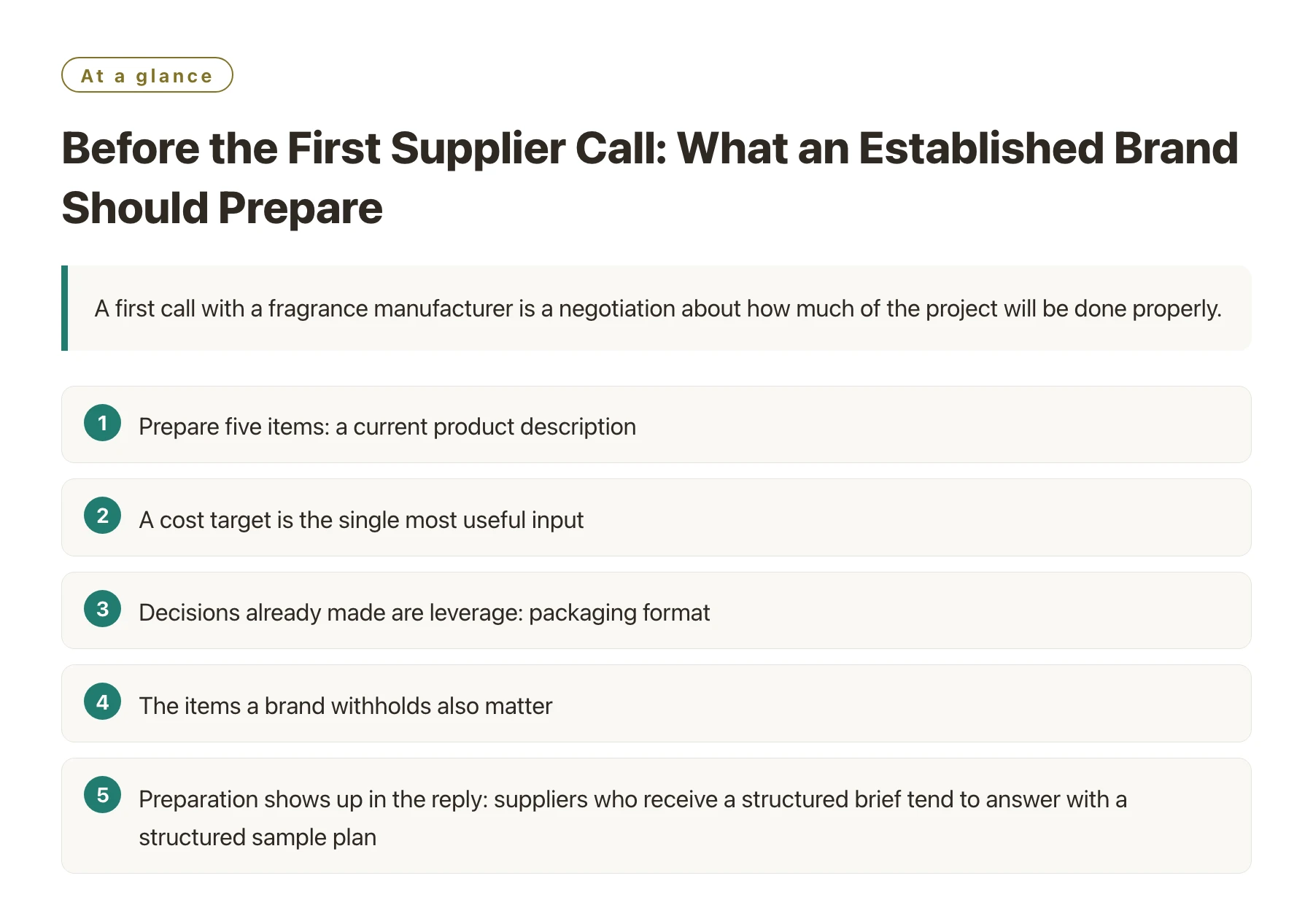
- Prepare five items: a current product description, a cost target with a range, a brief with its boundaries, the decisions already made, and a short list of what the brand will not share yet.
- A cost target is the single most useful input, not because suppliers should hit it but because it changes which materials and formats they propose in the first reply. [1]
- Decisions already made are leverage: packaging format, base type, market and launch window remove ambiguity, and suppliers price ambiguity rather than absorbing it.
- The items a brand withholds also matter; being clear that formula or pricing details are not yet shareable lets the supplier structure its answer around what is available.
- Preparation shows up in the reply: suppliers who receive a structured brief tend to answer with a structured sample plan, and that structure is itself the first evidence of capability. [2]
- After the call, write down what was asked and what was answered, because the second conversation is where the difference between a prepared supplier and a well-prepared brand becomes visible.
Most advice about supplier calls focuses on questions to ask. That framing puts the buyer in the position of extracting information from a supplier that may not have prepared anything, which is a poor use of the first meeting.
Preparation changes the exchange. A brief with boundaries tells the manufacturer that a project exists, and manufacturers allocate experienced people to projects. This checklist is written for brand owners, product managers and sourcing leads who want the first call to produce a costing route rather than a brochure.
The five-item preparation checklist
- 1. Current product descriptionCategory, format, packaging concept, base type and target shelf life. Even a one-page description is enough to move the conversation from general to specific; what the brand sells now also indicates the price tier the new line must sit in.
- 2. A cost target with a rangeA landed cost band, not a wish. State it as a range and say which components are inside it, since suppliers will otherwise assume the figure excludes decoration, filling or freight. [1]
- 3. A brief with boundariesWhat the scent must be, what it must not be, and the constraints that are fixed. Market, allergen limits and restricted-material concerns belong in this section, stated in advance. [2]
- 4. Decisions already madeFormat, bottle family, closure type, filling location preference and launch window. Each decision removed from the table reduces the number of assumptions the supplier has to price.
- 5. What you will not share yetFormula details, artwork and pricing structure are all reasonable to withhold at this stage. Saying so explicitly keeps the supplier from building an answer on documents you are not ready to release.
Why preparation changes the reply more than the questions do
A supplier allocates its most experienced people to the projects that look most likely to proceed. A structured brief with a cost range and fixed constraints signals a real project, and the reply usually reflects that allocation: a named project contact, a sample plan with stages, and questions that show someone read the brief.
By contrast, a general enquiry produces a general reply. That reply is not dishonest; it is rational. The supplier has no way to tell how serious the project is and no basis on which to spend technical time, so it sends the material that fits every enquiry.
This is why comparing replies only makes sense after the same prepared brief has gone to every supplier. Sending different levels of detail to different suppliers and then comparing answers measures your own preparation rather than their capability.
What to bring, what it answers, and what happens without it
| Bring this | The question it answers for the supplier | What its absence costs you |
|---|---|---|
| Product description | What category and tier is this really in? | Generic catalogue and a price band that will be revised |
| Cost range | Which materials and formats are viable? | Proposals outside the budget, and a second round of costing |
| Fixed constraints | What must the formula respect? | A sample built against the wrong market or label rules [2] |
| Decisions made | What is still open for us to propose? | Assumptions priced separately, discovered later |
| Launch window | How much schedule risk can be absorbed? | A lead time promise that was never checked against materials |
| Brand context | How much support will this brand need? | First-order friction, since nothing is known about your standards |
None of these items requires confidential information. They describe the product and the project, which is exactly what a manufacturer needs in order to decide whom to put on the call.
What to do in the forty-eight hours before the call
Write a one-page brief
One page is enough: category, format, target cost, market, launch window, and the three constraints that cannot move. Send it ahead with a note that the call will focus on the manufacturing route.
Read the supplier's own material first
Read what the supplier publishes about its process and scope before the call, and prepare two questions that reference it specifically. If a company describes a full production route from compounding to filling, ask which of those steps it owns and which sit with partners.
Decide what you are testing
Pick two things the call must establish: the costing route and the sampling route are usually the right pair. A call with a defined objective produces a decision; a call without one produces a follow-up meeting.
Agree who speaks
Decide in advance which internal function holds the technical relationship. A call with five brand-side voices and no owner tends to end in a summary email with no questions in it.
If the first call produces only a price and a lead time, the brief was not specific enough or the supplier does not have a technical route to describe. A second attempt with a sharper brief is worth making, because it tests whether the first reply was a template. Reading how a manufacturer presents its own sequence - for example the production scope and historical notes published on the Xuelei official site, and how a brand moves from brief to sealed bottle with a single partner from formula to finished bottle - gives you a reference for the level of detail a prepared answer contains.
After the call, before the next one
Send a short summary within a day: what was agreed, what remains open, and what the supplier will send and by when. This is a low-effort habit that filters suppliers quickly, because a supplier that responds to a written summary with a written answer is demonstrating document control.
Two or three prepared supplier calls usually produce enough information to build a costing comparison. Where the comparison is unclear, the missing input is nearly always a decision the brand has not made rather than information the supplier withheld. The most useful preparation is therefore internal: deciding what the product has to be before asking anyone to manufacture it.
Sources
- Cosmetics Europe —— The European trade association for the cosmetics and personal care industry, publishing guidance, positions and market information.
- IFRA Standards Library (International Fragrance Association) —— The IFRA Standards Library lists the restrictions the fragrance industry applies to individual fragrance ingredients, based on safety assessments; it is the reference point for compliant fragrance formulation.
Frequently asked questions
What should I prepare before a first call with a perfume manufacturer?
A one-page product description, a landed cost range, a brief with fixed constraints, the decisions already made such as format and market, and a note of what you are not yet willing to share. Send it ahead of the call so the supplier can put the right person on the line.
Should I share my cost target with a supplier?
Yes, as a range that states which components are included. A target changes which materials and formats are proposed and prevents a first costing that has to be discarded. Withholding it does not protect your negotiating position; it just produces proposals built on the supplier's assumptions.
How much product information is safe to share before signing anything?
Category, format, market, timing, cost range and constraints can all be shared without disclosing the formula, the artwork or the commercial structure. A mutual confidentiality agreement is worth arranging before detailed artwork or formula discussions, but it is not needed for the first conversation.
What if the supplier sends a catalogue anyway?
Send one specific technical question in writing and see whether the answer changes shape. If a technical contact appears and the reply gains structure, the first response was a default. If the second reply restates the first, the supplier does not have a technical route to describe.
How many suppliers should be on the first round of calls?
Three to five is a practical range for an established brand with a defined brief. Fewer than three makes comparison weak, and more than five tends to produce a long list of similar replies without a clear costing route. Prepare the same brief for all of them.